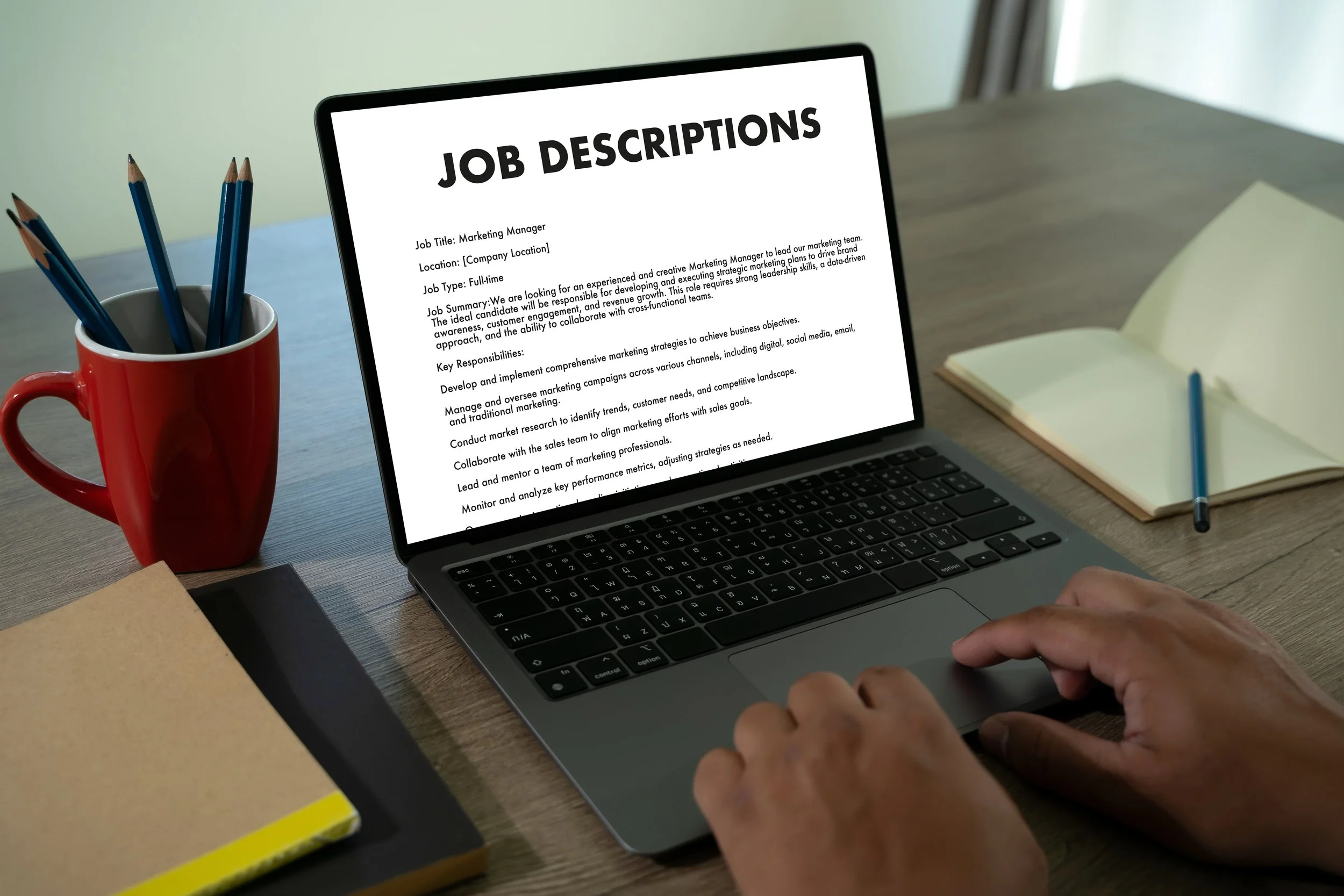
Job descriptions are often treated as simple administrative documents, something created during hiring and then forgotten. In reality, they are one of the most important tools an organization has to define roles, manage performance, and reduce risk.
When done correctly, job descriptions support everything from recruitment to compliance. When done poorly, or not maintained at all, they can create confusion, inconsistency, and legal exposure.
role of job descriptions
Job descriptions are not just helpful, they are often critical in employment-related decisions and disputes. They can serve as key evidence in:
SUPPORTING DISABILITY ACCOMMODATION DECISIONS
Job descriptions help define the essential functions of a role, which are central to determining whether an employee can perform the job with or without reasonable accommodation. Courts often rely on written job descriptions as evidence when evaluating disability-related claims. If essential duties are not clearly documented, employers may struggle to justify their decisions.
DETERMINING WAGE AND HOUR CLASSIFICATION
Accurate job descriptions are critical in classifying employees as exempt or non-exempt under wage and hour laws. Simply paying an employee a salary does not determine exemption status - their actual job duties do. A well-documented job description provides clear evidence of responsibilities and helps protect against misclassification claims and potential penalties.
ESTABLISHING CLEAR PERFORMANCE EXPECTATIONS
Job descriptions serve as the foundation for performance management. They communicate what is expected from employees and provide a benchmark for evaluating performance. In disputes involving performance or termination, employers are in a stronger position when they can show that expectations were clearly defined and communicated.
STRENGTHENING DEFENSE IN EMPLOYMENT DISPUTES
In many employment-related claims, whether related to discrimination, discipline, or termination, job descriptions become key supporting documents. They demonstrate that decisions were based on legitimate job requirements rather than subjective or inconsistent reasoning.
PROVIDING CONSISTENCY ACROSS THE ORGANIZATION
Beyond legal protection, job descriptions ensure consistency in how roles are defined, evaluated, and managed across teams. This helps reduce confusion, align expectations, and support fair and consistent decision-making.
PREPARATION OF JOB DESCRIPTIONS
Creating effective job descriptions requires a thoughtful and structured approach. It’s not just about listing tasks, it’s about accurately defining the role, setting expectations, and ensuring compliance.
CONDUCT A THOROUGH JOB ANALYSIS
Start by identifying the essential tasks of the position and the elements required to perform them successfully. This includes understanding day-to-day responsibilities, expected outputs, and how the role contributes to the organization.
DEFINE QUALIFICATIONS AND REQUIREMENTS
Clearly outline the knowledge, skills, abilities, and experience required for the role. This may include education, certifications, physical requirements, language proficiency, and any environmental factors (such as working conditions or exposure to specific elements).
IDENTIFY ESSENTIAL FUNCTIONS
Distinguish which tasks are critical to the role. Essential functions are especially important for compliance with disability laws, as they help determine whether an employee can perform the job with or without reasonable accommodation.
GATHER INPUT FROM EMPLOYEES AND MANAGERS
Employees who currently perform the role can provide valuable insights into the day-to-day realities of the job. While they should not write the job descriptions themselves, their input helps ensures accuracy and prevents missing key responsibilities. This also strengthens the credibility of the job description if it is ever questioned.INCLUDE PHYSICAL, ENVIRONMENTAL, AND ATTENDANCE REQUIREMENTS
Job descriptions should clearly state any physical demands (e.g., lifting, standing, repetitive tasks), working conditions (e.g., exposure to weather or chemicals), and attendance expectations. These details are important not only for clarity but also for compliance with laws such as the ADA and FMLA.
ENSURE ACCURACY AND REALISM
Job descriptions must reflect what employees actually do. Including tasks that are not performed, or omitting critical responsibilities, can weaken the document’s value. Courts and regulatory agencies are more likely to rely on job descriptions that accurately represent real job duties.
INCLUDE FLEXIBILITY FOR BUSINESS NEEDS
Because roles evolve over time, job descriptions should include language that allows for flexibility, such as, “other duties as assigned.” This ensures the organization can adapt without needing to rewrite the document for every minor change.
KEY COMPONENTS OF AN EFFECTIVE JOB DESCRIPTION
A strong job description should be clear, structured, and easy to understand. Most effective job descriptions include:
JOB TITLE – Clear and aligned with industry standards
JOB SUMMARY – A brief overview of the role’s purpose
KEY RESPONSIBILITIES – A prioritized list of core duties
REQUIRED QUALIFICATIONS – Must-have skills, education, and experience
PREFERRED QUALIFICATIONS – Additional skills that enhance candidate fit
WORKING CONDITIONS – Physical demands, environment, or travel requirements
REPORTING STRUCTURE – Who the role reports to and manages
COMPENSATION INFORMATION (when applicable)
The goal is to provide enough detail to define the role clearly without overwhelming the reader.
MANAGING AND UPDATING JOB DESCRIPTIONS
Job descriptions should never be treated as static documents. Outdated job descriptions can weaken their effectiveness and reduce their value as a protective tool.
Best practices include:
Reviewing job descriptions annually or when roles change
Maintaining a centralized system for storing and updating documents
Tracking revisions and approvals for accuracy and compliance
Using job descriptions in performance evaluations
If your organization hasn’t reviewed its job descriptions recently, it may be time to revisit them.
Explore how structured HR support can help strengthen your job descriptions, improve compliance, and support your organization’s growth. Contact us now!